
Reviewed · MOUNT COOK & LAKE TEKAPO TOURS
Lake Tekapo: Alpine Stargazing Experience with a Guide
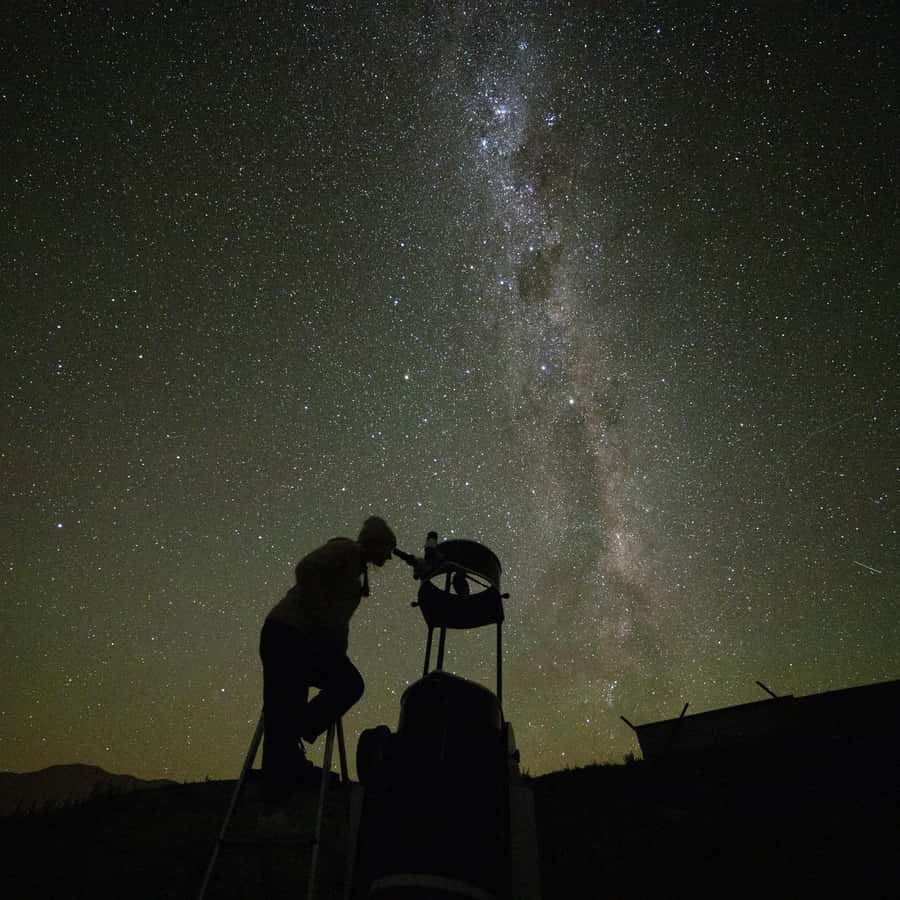
The first thing to know about this Lake Tekapo stargazing tour is that the naked-eye sky is the main event. From a private 50,000-acre farm, far from Tekapo’s glow, the Milky Way can look broad and bright enough to stop you in your tracks. The telescope adds close-up views of planets, star clusters, nebulae, and distant galaxies.
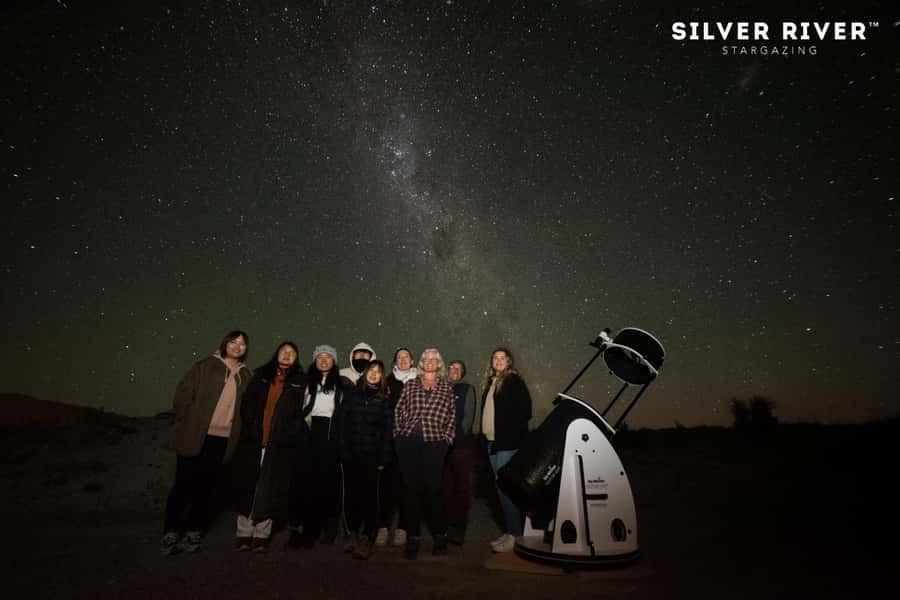
I like the small group, capped at 10 people, because you get a fair turn at the 14-inch telescope instead of waiting behind a crowd. I also like the practical touches: warm down jackets, a quick transfer to the farm, laser-guided explanations, and a complimentary photo beneath the stars. The main drawback is simple: clouds, wind, and moonlight can limit what you see, and 75 minutes can feel short if you want a long telescope session.
Key points at a glance
- The Milky Way without a telescope: The private farm has little to zero light pollution, giving you a strong chance to see the southern sky clearly.
- A powerful 14-inch telescope: Look at planets, the Moon, star clusters, nebulae, and other deep-sky objects when conditions allow.
- A small group of up to 10: The low headcount means more time to ask questions and use the telescope.
- Guides who make astronomy approachable: Sam, Tara, Nicole, JoJo, Marcus, and other guides are praised for clear explanations, humor, and enthusiasm.
- Warm clothing is provided: Long, warm down jackets help on cold and windy nights, though you should still dress in layers.
- A useful keepsake: You receive a digital group photo taken beneath the stars, usually sent by email within 48 hours.
Why Lake Tekapo is a superb place to see stars
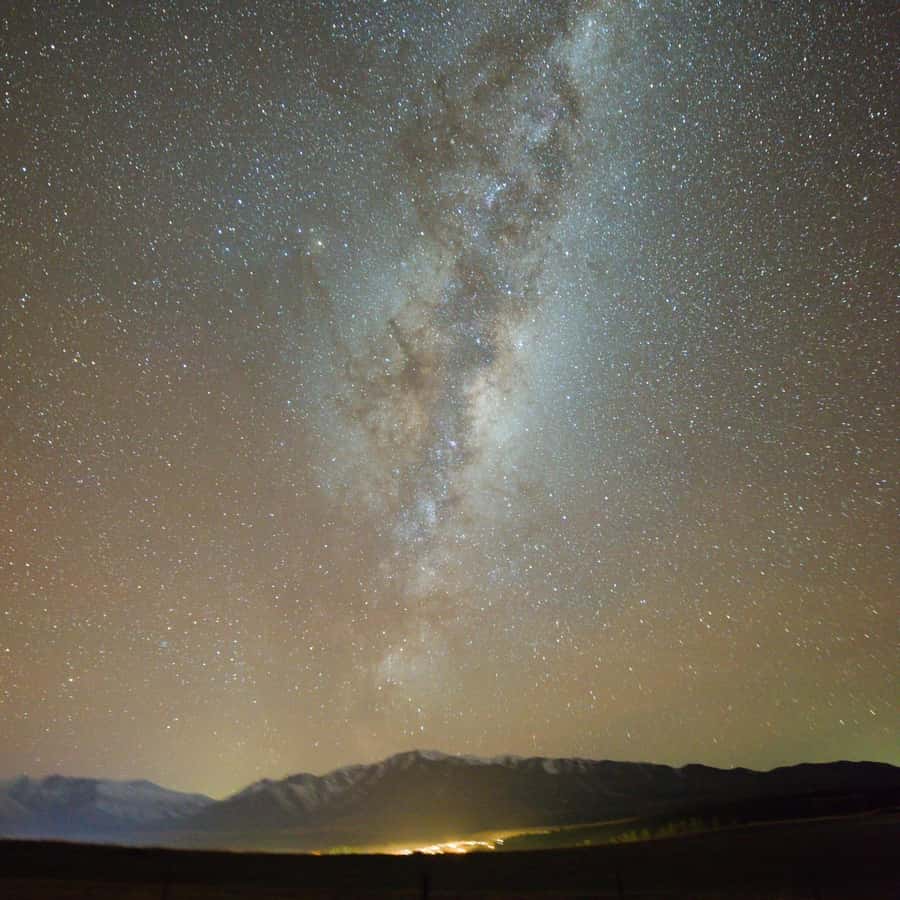
Lake Tekapo sits inside the Aoraki Mackenzie International Dark Sky Reserve, an area protected for its unusually low light pollution. That designation matters most when you simply look up. You do not need to understand astronomy to notice the difference between a dark rural sky and the washed-out view above a town.
The tour takes you away from Lake Tekapo’s lights to private farmland with wide, uninterrupted views. The setting offers a 360-degree view of the reserve, so the guide can point out stars and constellations across a broad section of sky rather than working around buildings, streetlights, or nearby distractions.
The southern hemisphere also gives this experience a different feel for many visitors. Depending on where you live, you may be seeing the Southern Cross, southern star fields, and the Milky Way from an entirely new angle. The guides explain how to find objects in the sky and often add stories about star names and the different traditions connected with them.
A dark sky is not a guarantee of perfect viewing. Clouds can block the telescope, wind can make the image shake, and a bright Moon can reduce the contrast of faint stars. Still, several experiences have worked well even with cloud or a nearly full moon, and one group managed to see stars despite a cloudy night. Keep your expectations flexible, and you will get more from the evening.
A few more Mount Cook & Lake Tekapo days to compare
- Lake Tekapo: Stargazing Experience
★ 4.9 · 607 reviews - Mount Cook: Scenic Helicopter Flight with Alpine Landing
★ 4.8 · 442 reviews - Mt Cook Small Group Scenic Day Tour from Queenstown
★ 5.0 · 407 reviews
Meeting at the Lake Tekapo post office
You begin at the Silver River Stargazing office inside Kiwi Treasure, the building that also serves as Lake Tekapo’s post office. This is easy enough to find once you know the landmark, but do not search only for a large observatory or a separate building with an obvious stargazing sign.
At check-in, you receive a short safety briefing lasting about five minutes. Warm down jackets are available before you leave, a welcome service on a clear night when the temperature drops quickly. The jackets are long and substantial, but I would still wear warm trousers, closed shoes, and several layers.
The tour is listed as wheelchair accessible, and small groups are available. English and Japanese tours are offered. If you are bringing an infant, there is a limit of one infant per tour, and the infant must be booked onto the earliest departure of the night.
The short ride to private farmland
After the briefing, you take a transfer to the viewing site. The ride is scheduled for about five minutes, though some departures have taken a little longer depending on the route and vehicle. Guides have used a bus or an older vehicle for the trip, and the ride can include a short rumble over farm tracks in the darkness.
This transfer is useful for two reasons. First, you do not need to arrange your own transport to a remote viewing spot. Second, it gets you away from Lake Tekapo’s stray light without spending much of the tour sitting in a vehicle.
The viewing area is prepared before you arrive, with chairs and the telescope set up. That is a small but important benefit. You are not asked to help assemble equipment in the cold, and the limited 75-minute schedule can focus on the sky rather than preparation.
One hour under the southern sky
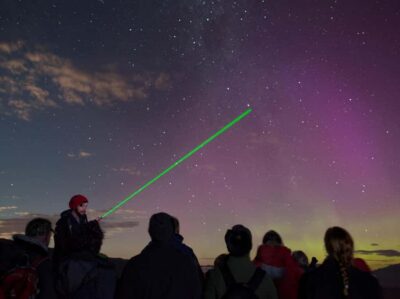
The main guided session lasts about an hour. The guide uses a special astronomy laser to trace constellations and show you where to look. This is far easier than hearing a star name and then trying to guess which faint point of light the guide means.
The laser is especially helpful for visitors who are new to astronomy. It also helped one visually impaired participant follow the guide’s explanations and connect the spoken description with the sky above. The guide can also explain how to use bright stars to find other parts of the sky, giving you a way to continue looking after the tour ends.
The strongest guides combine facts with stories. Sam has been praised for explaining the southern sky in an entertaining way, while Tara has been singled out for making complicated ideas simple and for answering children’s questions patiently. Nicole, JoJo, Marcus, Estelle, Keira, Wilson, Roselyn, and others have also been praised for warmth, humor, and clear instruction.
The experience is not a lecture you simply sit through. You look up, ask questions, follow the laser, and take turns at the telescope. The quality of the evening depends partly on the guide’s style, but the format gives a good guide plenty of room to make astronomy feel personal and understandable.
Somewhere else in Mount Cook & Lake Tekapo entirely:
- Tekapo Shuttle: Mt Cook Day Tour via Pukaki & Tasman Lake
★ 4.8 · 307 reviews - Mount Cook: Ski Plane and Helicopter Glacier Combo Flight
★ 4.6 · 271 reviews - Mount Cook: 3 Hour Heli Hike to the Tasman Glacier
★ 4.7 · 218 reviews - Chameleon Stargazing Shared Tour
★ 5.0 · 181 reviews
What you may see through the 14-inch telescope
The 14-inch telescope is the tour’s main piece of equipment. Its large mirror gathers more light than a small backyard telescope, making it possible to view dimmer objects when the sky and equipment are cooperating.
Past viewing opportunities have included the Moon, Jupiter, Saturn, Jupiter’s four moons, star clusters, galaxies, and nebulae. One group saw a neighboring galaxy, while another caught a meteor streaking through the sky. Those moments depend on the date, the current position of celestial objects, and the weather, so they cannot be promised on every departure.
The telescope view may look different from what you expect. You are not watching a colorful space photograph on a screen. Some objects appear as pale shapes or small points, but seeing them directly through the eyepiece gives the experience a satisfying sense of scale. The guide helps you understand what you are seeing and why it matters.
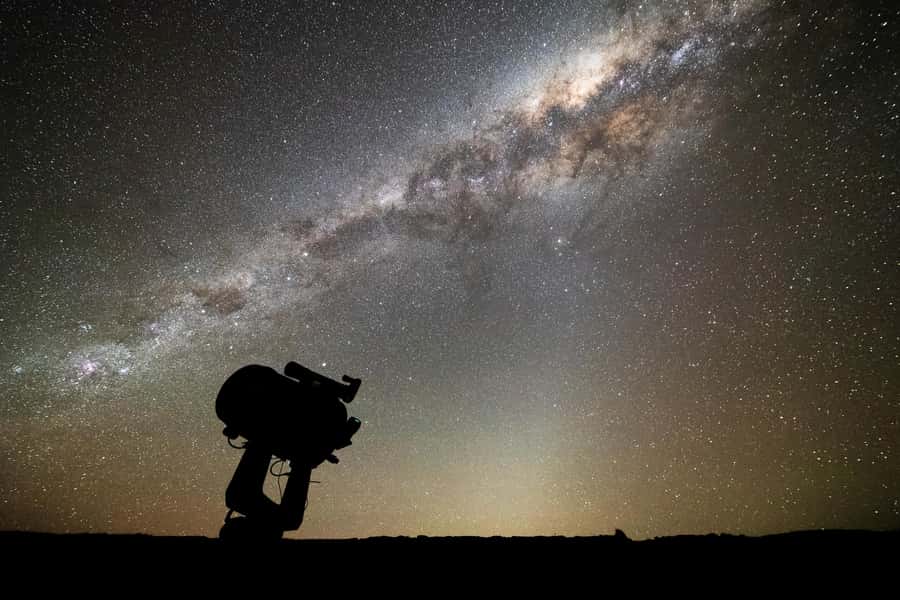
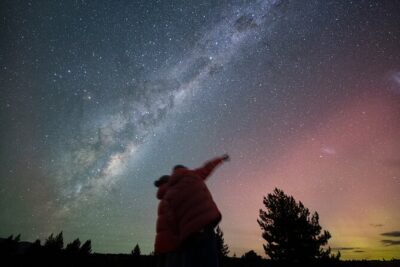
You should also give plenty of attention to the unaided view. Several of the strongest moments reported from this tour came before anyone looked through the telescope. Under a dark Tekapo sky, the Milky Way can be visible as a thick band, with dense star fields and brighter patches. The telescope is a fine addition, but the darkness of the farm is what makes the entire evening work.
How weather and moonlight affect the evening
Astronomy tours always depend on the sky, and this one is no exception. Clear conditions can reveal a huge number of stars, while cloud may block the telescope entirely. Wind can also make telescope images less steady, especially when the instrument is pointed at a planet or another small object.
The guides generally make the most of partial conditions. A cloudy evening has still produced useful explanations and some views of the stars. A nearly full moon has not prevented a good session, although moonlight can make faint parts of the Milky Way less visible.
A new moon is ideal if your main goal is to see the faintest stars and the Milky Way at its strongest. A full or bright moon can still be worthwhile if you want a crisp lunar view, but it changes the balance of the evening. Ask about the moon phase when choosing your date if you have flexibility.
Aurora Australis sightings are another possible bonus, not a scheduled part of the experience. One evening included a strong southern aurora, turning a good stargazing session into a rare spectacle. Do not book this tour as an aurora hunt, but keep an eye on the sky if conditions are favorable.
Cold-weather comfort and what to bring
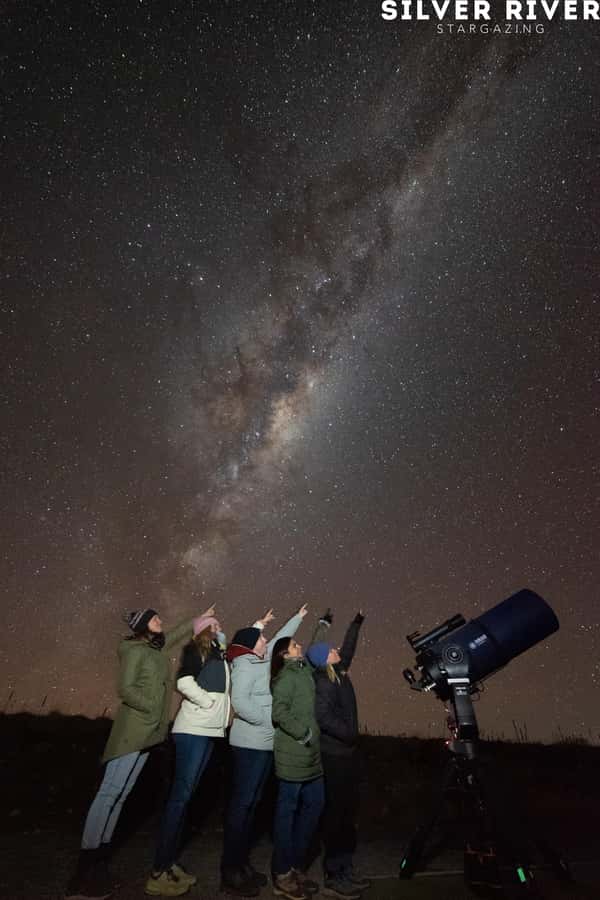
The supplied down jackets are one of the tour’s most useful details. They make a real difference during a stationary outdoor activity, especially after sunset and on the exposed farmland. Chairs are also available, so you are not standing for the entire hour.
Still, the jackets are a backup rather than a complete cold-weather kit. Bring a warm base layer, a fleece or sweater, long trousers, and sturdy shoes. Gloves and a hat are sensible additions, particularly in winter or when the forecast calls for wind.
Hot drinks and blankets are not included. One family would have liked those extras, but the provided jackets made the outing comfortable enough. If you feel the cold easily, bring a thermos if practical and avoid arriving in light clothing simply because the evening began mild in town.
Is 75 minutes enough time?
The full experience lasts 75 minutes: roughly five minutes for the briefing, five minutes to reach the farm, about an hour at the viewing site, and five minutes to return. That is a tidy format for an evening in Tekapo, especially if you have dinner plans or are fitting stargazing between daytime activities.
The tradeoff is telescope time. With up to 10 people sharing the equipment, each person may not get as long at the eyepiece as a dedicated observatory visitor would. A few people have wished for more time, particularly when several planets or objects were available.
The small group keeps this from becoming a serious problem. You are not one person in a large crowd, and the guide can answer questions while others take their turns. If you want a slow, highly technical astronomy session, seek a longer specialist program. If you want an efficient introduction with both naked-eye viewing and a large telescope, 75 minutes is a reasonable length.
What the $59 price includes
At $59 per person, the price covers the guided tour, return transport from the Silver River Stargazing office, a warm down jacket, use of the 14-inch telescope, and a digital group photo. The value comes from the combination rather than any single feature.
You could look at the stars around Lake Tekapo without paying for a tour, and the darkness alone may give you a memorable evening. What you would miss is the guide’s ability to identify constellations, explain how to navigate the sky, operate the telescope, and place what you see in a wider story.
The included photo adds useful value. The guide takes a group photograph beneath the stars, weather permitting, and sends a digital link within 48 hours. The result gives you a record of the dark sky that is difficult to capture with an ordinary phone.
The tour also removes small hassles. You do not need to drive a dark farm road, bring specialist equipment, or guess which stars you are looking at. For many people, that makes $59 a fair price, particularly if this is your first visit to a major dark-sky area.
Who will enjoy this tour most?
I would choose this experience for first-time stargazers, families with older children, couples, solo visitors, and anyone who wants an easy introduction to the southern sky. The guides are used to explaining astronomy in plain language, and children have been able to follow along and ask questions.
It also suits photographers, though you should not treat the included photo as a personal astrophotography workshop. You get a complimentary group image, not a lesson in camera settings or a private portrait session.
People with strong astronomy backgrounds may want more telescope time and a more technical format. You might also be disappointed if you are visiting during a cloudy spell and expect a guaranteed view of galaxies or planets. The company cannot control the weather, so choose this tour for the setting, the guide, and the chance to see the sky, not for one specific object.
The English and Japanese language options make the tour useful for a wider range of visitors. The wheelchair-accessible format is another practical advantage, though it is still wise to confirm any personal mobility needs when booking.
Booking tips for a better night
Check the forecast and moon phase, but do not assume a partly cloudy forecast means the evening is lost. Conditions can improve after sunset, and the guides may still provide a worthwhile session when only part of the sky is open.
Book early if your dates are fixed, since the group limit is only 10 people. The experience allows free cancellation up to 24 hours before departure, and you can reserve now and pay later, which helps if your South Island plans are still shifting.
If you are traveling with an infant, select the earliest departure. Arrive at Kiwi Treasure with enough time to check in and collect a jacket. Finally, keep your phone away for a few minutes once you reach the farm. The first clear look at the Milky Way is best enjoyed before you start taking pictures.
Should you book Lake Tekapo Alpine Stargazing?
Yes, if you want a well-organized way to see the southern night sky and learn what you are looking at. The private farmland, small group, strong telescope, warm jackets, and free digital photo make this more useful than simply walking outside town and hoping to recognize a constellation.
Book it with realistic expectations. Weather may reduce the telescope views, the session is fairly short, and a bright moon can soften the Milky Way. But if the sky opens, the combination of extreme darkness and an engaging guide can make this one of the most memorable evenings of your South Island trip.
FAQ
Where does the Lake Tekapo stargazing tour meet?
Meet at the Silver River Stargazing office inside Kiwi Treasure, which is also the Lake Tekapo post office.
How long does the experience last?
The total duration is 75 minutes, including the safety briefing, transfers, and guided stargazing session.
How far is the stargazing site from the meeting point?
The transfer is scheduled to take about five minutes each way.
How large is the tour group?
The experience is capped at 10 people, and small-group departures are available.
What telescope is used?
You use a modern 14-inch telescope to view deep-sky objects and other celestial sights.
Are warm clothes provided?
Warm down jackets are provided for use during the outdoor session. Hot drinks and blankets are not included.
Which languages are available?
The live guide options are English and Japanese.
Is the experience wheelchair accessible?
Yes, the activity is listed as wheelchair accessible.
What happens if I need to cancel?
You can cancel up to 24 hours in advance for a full refund. The tour also offers a reserve-now, pay-later option.
Newly listed around Mount Cook & Lake Tekapo
- Mount Cook: 20-Minute Alpine Vista Helicopter Flight★ 4.2 · 5 reviews
- Lake Tekapo to Mt Cook One-Way Small Group Tour★ 4.0 · 5 reviews
- Mount Cook: Alpine Explorer 35 Minute Flight★ 4.9 · 6 reviews
- Mount Cook: Tasman Glacier and West Coast Helicopter Flight★ 5.0 · 6 reviews
- Mount Cook Scenic 35 Minute Helicopter Flight★ 5.0 · 6 reviews
- Mt Cook: 55-Minute Scenic Flight in Helicopter or Ski Plane★ 4.1 · 6 reviews
- Mount Cook: Glentanner High Country Heli Hike★ 5.0 · 7 reviews
- Mount Cook: Tasman Glacier Helicopter Flight★ 4.3 · 7 reviews
Mount Cook & Lake Tekapo Tours, compared.
Mt Cook Small Group Scenic Day Tour from Queenstown
Read our review →
Tekapo Shuttle: Mt Cook Day Tour via Pukaki & Tasman Lake
Read our review →
Browse the lists this tour appears in