
Reviewed · MOUNT COOK & LAKE TEKAPO TOURS
Mount Cook: Mountains High 40-Minute Helicopter Flight
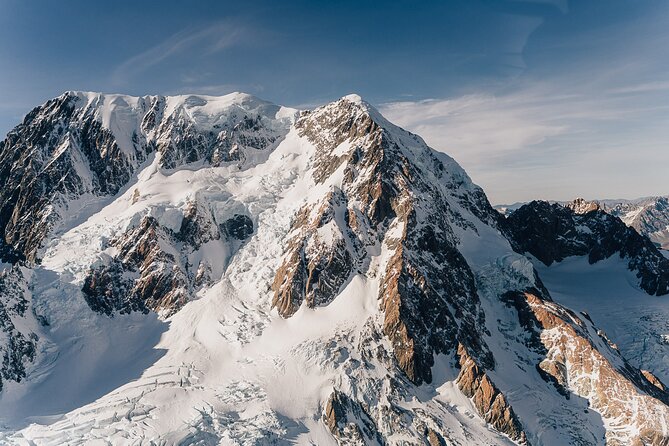
Landing on snow above the Tasman Glacier is the clear star of this flight. From the helicopter, you see Aoraki/Mt. Cook from an angle that is impossible to reach by road, then step out into the cold alpine air with New Zealand’s highest peak rising nearby.
I like the small maximum group of six, which keeps the cabin from feeling crowded, and I like the wide route: glaciers and icefalls give way to the Burnett Mountains, Mackenzie Basin, and distant waterways. The main caution is that snow landings depend on weather and seasonal conditions, so the advertised landing cannot always happen.
- Snow landing: Spend about 5 to 10 minutes on an alpine ice or snow field above the Tasman Glacier.
- Aoraki/Mt. Cook views: See the 12,217-foot, or 3,724-meter, summit from the air and from near the upper Tasman Glacier.
- Hochstetter Icefall: Fly past this dramatic ice feature on the way toward the glacier.
- Changing scenery: Look from glaciated peaks to the dry Mackenzie Basin and Burnett Mountains.
- Pilot commentary: Your pilot guides the flight and explains natural features, local geography, and the route.
- Weather-sensitive timing: Poor conditions can mean a delay, route change, or full refund.
The Snow Landing Is the Main Event
A scenic flight around Mount Cook is already a fine way to see the Southern Alps. The snow landing changes the experience from a view through glass into a short alpine encounter.
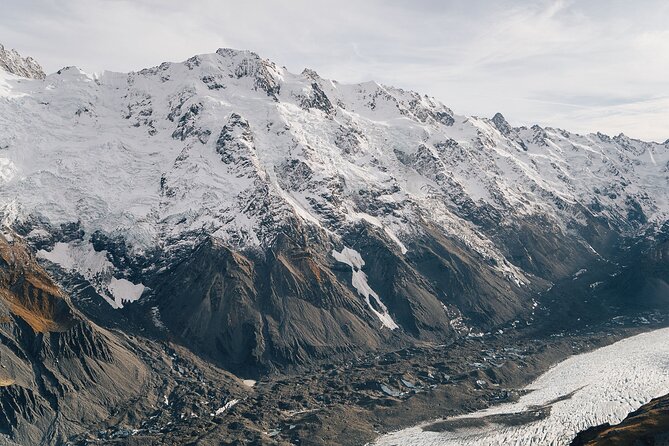
After leaving the base, the helicopter heads toward the Hochstetter Icefall and upper Tasman Glacier. You hover above broad ice fields before the pilot settles onto a suitable snow or ice landing area. If conditions are right, you get 5 to 10 minutes outside the aircraft.
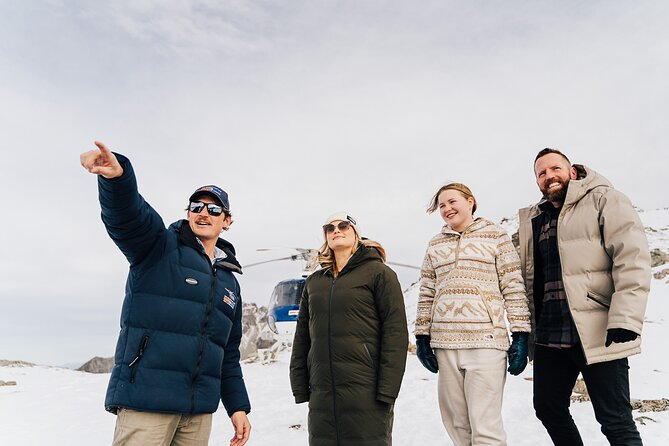
That short time is enough to take photographs, look across the glacier, and feel the scale of the mountains around you. The cold is real, so warm clothing and sturdy footwear matter. This is not a long walk or a glacier trek. It is a brief, memorable pause in a remote setting, followed by the flight back through the mountains.
Aoraki/Mt. Cook rises to 12,217 feet, or 3,724 meters. From the valley, the summit can be hidden by cloud or partly blocked by closer ridges. From the helicopter, you gain a much clearer sense of how the peak relates to the surrounding ice fields and ranges.
The best flights happen on clear days, when the major peaks and glaciers come into view. One practical point is worth stressing: the snow landing is not guaranteed. Summer conditions, limited snowfall, warm temperatures, and changing alpine weather can leave the operator landing on a field of ice or another suitable surface instead.
What You See Between Glentanner and Tasman Glacier
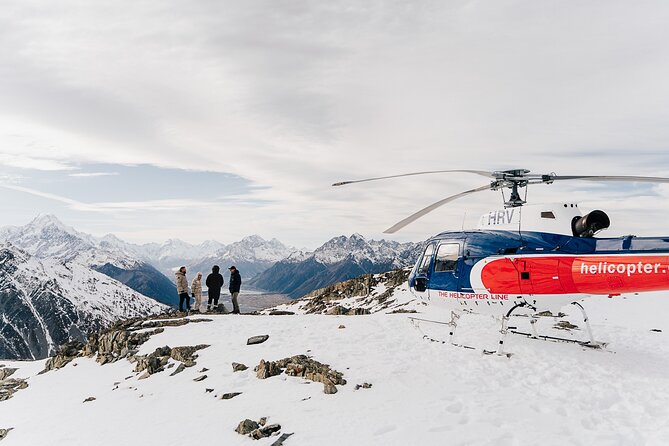
You make your own way to The Helicopter Line base at Glentanner Park, on State Highway 80. This is the meeting point both before and after the flight, so plan your day around getting there rather than expecting hotel pickup.
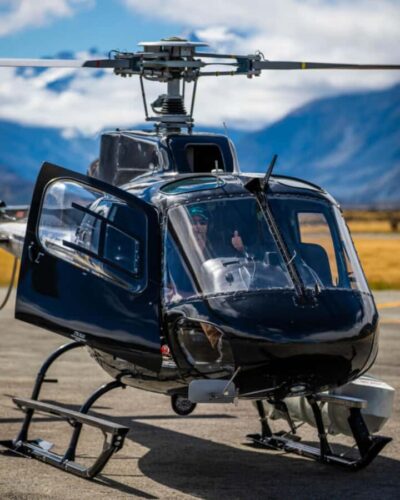
The helicopter cabin is open-plan and carries up to six passengers. That small capacity helps with visibility, although seating still matters. The aircraft has two front seats and four rear seats, and seating may be rotated after the landing so some people can enjoy a front position during the return portion.
If you care about photography or an unobstructed view, ask how seating will work before takeoff. Clear communication helps prevent the awkward scramble that can happen when several people want the same seats.
Once airborne, the pilot becomes your guide. The route passes the Hochstetter Icefall, a striking section of broken ice below Aoraki/Mt. Cook, then continues toward the upper Tasman Glacier. The pilot points out natural features through the headset, so the commentary adds useful context to what could otherwise become a series of impressive but hard-to-identify views.
Headset quality matters here. Most of the cabin may hear the pilot well, but one passenger reported difficulty understanding the commentary. If you cannot hear clearly, tell the crew or pilot early. A scenic flight works best when you know what you are looking at.
More helicopter flights over Mount Cook & Lake Tekapo:
- Mount Cook: Scenic Helicopter Flight with Alpine Landing
★ 4.8 · 442 reviews - Mount Cook: Ski Plane and Helicopter Glacier Combo Flight
★ 4.6 · 271 reviews - Mount Cook and The Glaciers 55-Minute Helicopter Flight
★ 4.5 · 133 reviews
Hochstetter Icefall and the Upper Tasman Glacier
The first major part of the route focuses on ice. The Hochstetter Icefall is not simply a white slope. It is a broken, steep section where the glacier’s movement creates ridges, cracks, and jumbled blocks of ice.
From above, you can take in its shape far better than from the valley floor. The helicopter gives you a close view while keeping you high enough to understand the scale of the feature. The upper Tasman Glacier then spreads out below, linking the icefall, mountain walls, and higher snowfields into one immense alpine setting.
This is where the flight earns much of its price. A road trip can bring you to viewpoints around Aoraki/Mt. Cook National Park, and walking routes offer their own rewards, but neither gives you this combination of height, distance, and access to remote glacier country in such a short time.
The tradeoff is time. Forty minutes passes quickly, and the flight cannot linger over every peak. If you want a long outing on a glacier, this is the wrong product. If you want to see a large portion of the region without committing to a full-day hike or multi-day mountain trip, it is a strong fit.
Aoraki/Mt. Cook From the Snow
The landing area is the emotional high point of the trip. You step from the helicopter onto snow or ice, with the Tasman Glacier and Aoraki/Mt. Cook forming the backdrop.
This is also the best chance to make photographs that do not look like ordinary sightseeing shots. The helicopter itself, the snow underfoot, and the mountain peak combine to show where you are. Keep your camera ready, but do not spend the entire stop looking at a screen. Five to 10 minutes is brief.
Your footwear should be suitable for cold, uneven ground. The information provided for this activity recommends warm clothing and appropriate shoes because temperatures can be low even when the valley feels mild. That advice is practical, not fussy.
Do not book this flight assuming the helicopter will always land on a thick, pristine glacier. The operator has explained that seasonal snow, climate conditions, and previous winter snowfall can affect the landing site. Some flights use an ice field or another alpine snow surface instead. The mountain setting remains impressive, but the exact landing may differ from the image you had in mind.
Burnett Mountains and the Mackenzie Basin
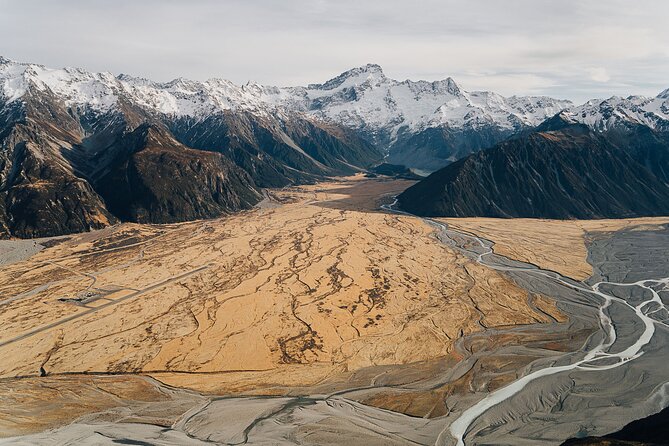
After leaving the glacier, the flight shifts from close-up ice to broad mountain views. The helicopter crosses the Burnett Mountains, a more remote section of the Southern Alps, while the Mackenzie Basin opens below.
This change gives the flight a useful sense of scale. You begin with details such as icefall and glacier texture, then move toward wide views of ridges, open country, and waterways. The Mackenzie Basin is notably drier and more open than the rainier West Coast side of the South Island, so you see several types of scenery during one short circuit.
The route can include sparkling waterways running toward native rainforests farther west. Your pilot’s commentary helps connect these features rather than leaving you to guess which range or basin you are seeing.
Several pilots have received praise for their explanations and calm manner, including Gillie, Richard, and Marcus. The exact pilot depends on the operating day, but the pilot-guide role is part of the experience, not an optional extra. You get both the flight and a running explanation of the region.
The helicopter may feel bumpy at times. That is normal for an alpine flight, where wind moves around ridges and peaks. One passenger appreciated being reassured when the aircraft encountered rougher air. If you are nervous about helicopters, let the staff know. The flight is thrilling, but it is still operated around mountain weather and wind.
A few more Mount Cook & Lake Tekapo days to compare
- Lake Tekapo: Alpine Stargazing Experience with a Guide
★ 4.5 · 626 reviews - Lake Tekapo: Stargazing Experience
★ 4.9 · 607 reviews - Mt Cook Small Group Scenic Day Tour from Queenstown
★ 5.0 · 407 reviews - Tekapo Shuttle: Mt Cook Day Tour via Pukaki & Tasman Lake
★ 4.8 · 307 reviews
How Much Value Do You Get for $416.90?
At $416.90 per person, this is a major splurge. You are paying for a 40-minute flight, a pilot guide, and a snow landing lasting roughly 5 to 10 minutes. Personal purchases are not included.
The price makes more sense if you value access and time. Reaching the upper glacier country on foot would take far longer and require a level of planning and fitness that this flight does not. In less than an hour, you see Aoraki/Mt. Cook, the Tasman Glacier, Hochstetter Icefall, Burnett Mountains, and Mackenzie Basin from changing viewpoints.
I would be more cautious if you are mainly paying for a guaranteed glacier landing. That part can change because of conditions. You should also understand the route as described: it centers on the Tasman Glacier and nearby alpine areas, not necessarily Fox Glacier or Franz Josef Glacier. If a booking page elsewhere promises a much wider western glacier route, confirm the exact flight before paying.
The value is strongest for a special occasion, a short visit to Mount Cook, or a person who wants a high-impact view without a long mountain outing. It was used as a honeymoon treat and a Christmas present, which tells you something about its role in a New Zealand trip. This is an experience people often build a day around, not a casual add-on.
Weather, Cancellations, and the Risk of Waiting
Good weather is essential. Low cloud can hide the peaks, while wind can affect the route and landing. The flight may be rescheduled, modified, or canceled when conditions are unsuitable.
The operator offers a different date or a full refund if poor weather cancels the experience. If you have flexibility, placing this flight early in your Mount Cook stay gives you a better chance of moving it to another day.
You can cancel for a full refund up to 24 hours before the scheduled start time. Cancellations or changes inside that 24-hour window are not refunded or accepted. The same local-time cutoff applies to the booking.
Please provide your preferred flight time when booking, but treat it as a request rather than a promise in a weather-sensitive setting. Confirmation is issued at booking, and the flight requires a minimum number of people to operate.
Group Size, Comfort, and Practical Limits
A maximum of six people keeps the flight personal, but the cabin is still compact. The open-plan design gives good viewing, though you should not assume every passenger will have the same angle at every moment.
The total weight limit is 331 pounds per passenger. This is an important booking detail, and you should check it if your body weight or combined passenger arrangements may affect the limit.
Most people can take part, and children must be accompanied by an adult. Physical access can require extra help. One family managed to assist a physically disabled son into the helicopter with a small step stool and lifting, but this should not be treated as a general guarantee of easy access. Contact the operator before booking if anyone in your group needs mobility assistance.
Wear warm layers and suitable footwear. The valley can feel comfortable while the landing area remains cold. You should also protect cameras and phones from the risk of being dropped in snow or ice, especially during the short outdoor stop.
Who Will Enjoy This Mount Cook Flight Most?
I would recommend it to you if you want the biggest possible view of the Aoraki/Mt. Cook region in a short time. It suits photographers, couples marking a special occasion, families with older children, and anyone who does not want to spend a full day on a demanding alpine route.
It is also a good choice if you have only one day around Mount Cook and want to see beyond the valley viewpoints. The flight covers a broad area and gives you a better understanding of the region’s scale than a single roadside lookout can provide.
I would hesitate if you have a strict budget, dislike flying, or would be deeply disappointed by a changed landing site. The snow landing is a highlight, but nature controls the terms. You also need to accept that commentary depends on working headsets and clear communication inside the aircraft.
Should You Book It?
Book this Mount Cook helicopter flight if the idea of standing briefly on snow above the Tasman Glacier feels worth a serious splurge. The strongest version of the experience combines clear weather, working headsets, fair seat rotation, and a true snow landing, with the flight then sweeping across the Burnett Mountains and Mackenzie Basin.
Before confirming, check the route, ask about the preferred flight time, and understand that the landing location can change. If those conditions suit you, this is one of the most efficient ways to see the Southern Alps from above and get close to Aoraki/Mt. Cook without a major expedition.
FAQ
Where does the helicopter flight begin?
The flight begins at The Helicopter Line at Glentanner Park, State Highway 80, Glentanner 7999, New Zealand. You make your own way to the base.
How long is the experience?
The flight lasts about 40 minutes. The snow or ice landing takes approximately 5 to 10 minutes within that flight.
Is a snow landing included?
A scenic helicopter flight with a snow landing is included, but the landing cannot always take place on snow because of weather, seasonal conditions, and snowfall levels. The aircraft may use an ice field or another suitable alpine landing area.
What sights does the flight include?
The route passes the Hochstetter Icefall and upper Tasman Glacier, then continues through the Burnett Mountains with views over the Mackenzie Basin and waterways leading toward the West Coast rainforests.
How many people can join the flight?
The helicopter carries a maximum of six travelers.
Is commentary provided?
Yes. Your pilot acts as a guide and provides commentary about natural features and the region during the flight.
What should I wear?
Warm clothing and suitable footwear are recommended because temperatures can be cold at the alpine landing site.
What happens if bad weather cancels the flight?
If poor weather cancels the experience, you can choose a different date or receive a full refund. If you cancel yourself, a full refund is available when you cancel at least 24 hours before the start time.
Newly listed around Mount Cook & Lake Tekapo
- Mount Cook: 20-Minute Alpine Vista Helicopter Flight★ 4.2 · 5 reviews
- Lake Tekapo to Mt Cook One-Way Small Group Tour★ 4.0 · 5 reviews
- Mount Cook: Alpine Explorer 35 Minute Flight★ 4.9 · 6 reviews
- Mount Cook: Tasman Glacier and West Coast Helicopter Flight★ 5.0 · 6 reviews
- Mount Cook Scenic 35 Minute Helicopter Flight★ 5.0 · 6 reviews
- Mt Cook: 55-Minute Scenic Flight in Helicopter or Ski Plane★ 4.1 · 6 reviews
- Mount Cook: Glentanner High Country Heli Hike★ 5.0 · 7 reviews
- Mount Cook: Tasman Glacier Helicopter Flight★ 4.3 · 7 reviews
Mount Cook & Lake Tekapo Tours, compared.
Mt Cook Small Group Scenic Day Tour from Queenstown
Read our review →
Tekapo Shuttle: Mt Cook Day Tour via Pukaki & Tasman Lake
Read our review →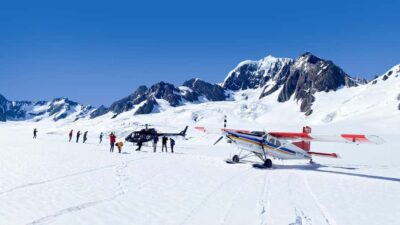
Browse the lists this tour appears in